
Air Duct Cleaning: Repair or Replace? How North Hills Homeowners Decide
Age is the wrong question. The right one is how much your current ductwork is costing you in energy loss, air quality, and wear on the HVAC equipment it feeds. We’ve walked into North Hills homes with 25-year-old sheet metal that measured tight and well insulated, and homes half that age where flex duct had pulled apart at half a dozen joints. One was worth cleaning and keeping. The other was quietly draining money every month. Here’s how to tell which situation you’re in before anyone quotes you a number.
What’s the direct answer on repair versus replace?
Repair and seal when the ductwork is structurally sound and the leakage is concentrated at joints, boots, and connections. Replace when the duct material itself is failing – collapsed flex, waterlogged duct board, crushed runs, or so many separations that sealing becomes patchwork. Cleaning comes first in almost every case, because cleaning is what tells you which of those two you’re actually facing. A surface look from the crawlspace hatch doesn’t.
That sequence matters. Cleaning is diagnostic as much as it is maintenance. Once the interior is clean and the technician can see and measure the full run, the repair-or-replace call stops being a guess.
If you’d rather not climb into a vented crawlspace in July to find out, call (844) 443-4850 and we’ll take a look.
What actually gets measured in a credible assessment?
A real assessment produces numbers, not adjectives. Four measurements carry most of the decision in North Hills:
- Duct leakage rate. A duct blaster test pressurizes the system and measures how much air escapes. A blower door test measures whole-house envelope leakage so you can separate duct loss from general air infiltration. Either way, you want a percentage, not “looks leaky.”
- Insulation R-value against the NC climate zone. Ducts running through a vented crawlspace or attic here face hot, humid summers and cold snaps. R-4 flex in an unconditioned space is thin for this climate; R-8 is a different conversation.
- Number and severity of disconnections. One separated boot is a repair. Six along a single trunk line starts pointing the other direction.
- Material condition by type. Sheet metal dents and separates but can often be sealed and reused. Flex duct tears, sags, and collapses – once the inner liner is torn, the run is compromised. Duct board that has taken on moisture is done.
Notice what isn’t on that list: the age of the system. Age tells you where to look harder, not what to conclude.
When does cleaning make economic sense before you repair anything?
Cleaning makes sense first when the system is sound but loaded with debris – and in our experience that’s most North Hills homes we open up. Dust, pet hair, and construction residue pile up in return plenums and trunk lines in ways no camera poked through a floor register can show you. Cleaning reveals the true condition of the ductwork: the seams, the liner, the joints, the insulation facing.
It’s also cheaper than guessing. If cleaning and a leakage test show the system is tight and the insulation is adequate, you’ve answered the question for the cost of a cleaning you needed anyway. You maintain what you have and move on.
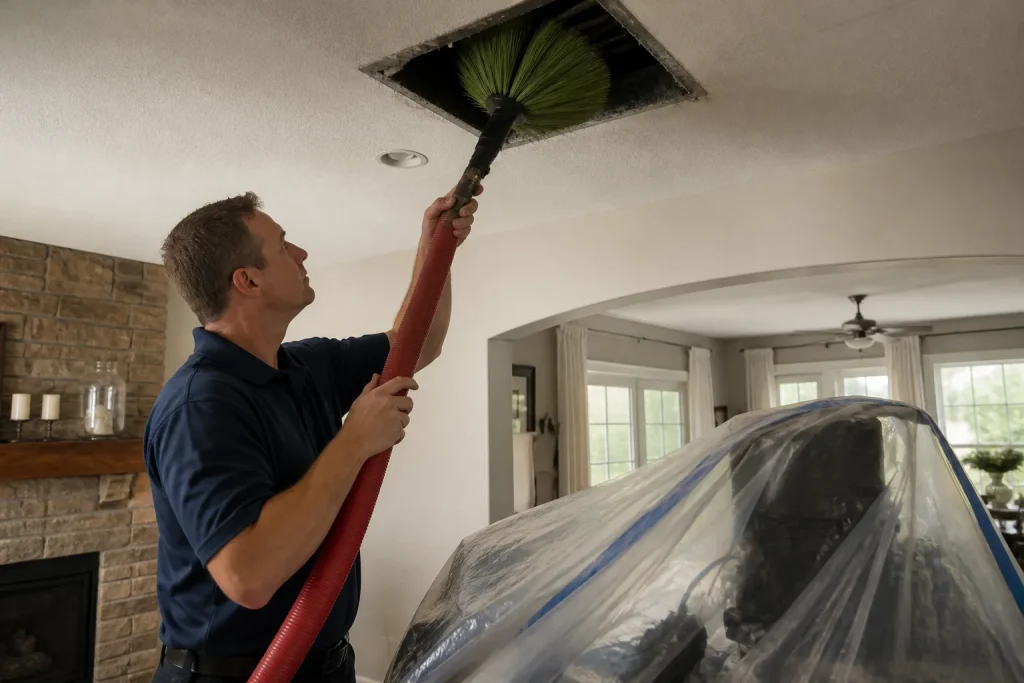
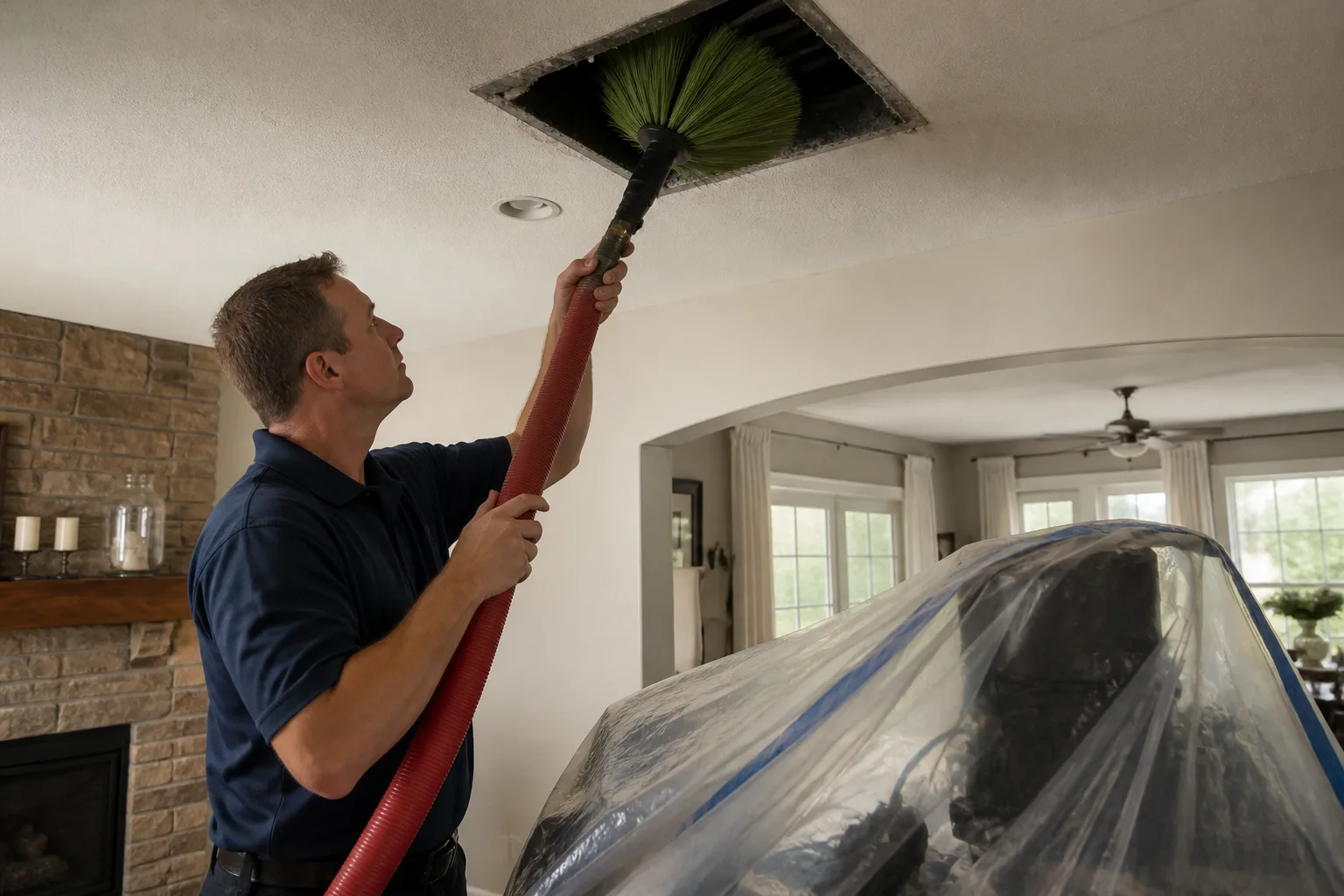
We run air duct cleaning with Rotobrush rotary brush systems and Nikro negative-air machines, so debris is captured under controlled suction instead of being pushed back into the living space. That’s the difference between a cleaning that lets you inspect the ducts properly and one that just moves dust around. When damage shows up mid-clean, we handle sealing and repair in the same visit rather than sending you to find a second contractor.
How do the three options compare on cost?
Three paths exist, and they solve different problems. Typical estimated ranges for North Hills homes:
| Option | What it addresses | Typical estimated range |
|---|---|---|
| Professional cleaning plus targeted sealing | Debris removal, joint and boot leakage, minor separations | $400 to $1,200 |
| Targeted repair and duct sealing | Disconnected runs, crushed flex, damaged boots, mastic and mesh at seams | $500 to $2,000 |
| Duct encapsulation or partial replacement | Aging or moisture-damaged duct board, failing flex, thin insulation in unconditioned space | $2,500 to $6,000 or more |
These are estimates only – the written estimate after inspection sets the final price, and it’s one flat price per system agreed before any work starts. We don’t price per vent, because a per-vent figure tells you nothing about what happens when a technician finds six disconnected joints.
The comparison that matters isn’t replacement cost versus repair cost. It’s repair cost versus what a leaky, underinsulated system costs you in energy and equipment wear over a few years. A system losing conditioned air through a dozen gaps makes the air handler run longer every cycle. That bill arrives monthly and nobody itemizes it.
Why does duct condition change the HVAC sizing question?
Here’s the part most homeowners don’t hear until after the work is done. A leaky duct system forces the HVAC equipment to run longer and harder than the house actually requires. Once that leakage is sealed and the ducts are properly insulated, the system delivers more of the air it was always supposed to move – and sometimes the air handler turns out to be oversized for the now-tighter ductwork.
That’s not a reason to avoid repair. An oversized system short-cycles, which means it cools the air but doesn’t run long enough to pull humidity out of a North Hills summer. Sealing the ducts and getting the equipment matched to the real load is the better outcome; it just requires planning the work with the sizing question in mind rather than discovering it after the fact. We look at the whole airflow chain – supply and return ducts, the air handler, the components – so sealing doesn’t create a new mismatch. Our HVAC cleaning work covers that side of the system.
Pairing the sealing with filtration upgrades we install from Honeywell and Aprilaire also keeps the newly sealed system from filling back up with the same debris that started the conversation. And while we’re in the system, we clean dryer vent cleaning – lint buildup in a dryer vent is a documented fire risk, and it’s the same airflow logic at work.
What separates a real assessment from a sales pitch?
The technician who measures before recommending, versus the one who recommends on sight. That’s the whole test. A credible assessment looks like this:
- Tools come out before opinions do. Leakage testing, photos of the interior of the ducts, actual measurements.
- You see the before-and-after photos of your own ducts, not stock images.
- The recommendation names specific problem areas – this boot, that run – instead of “your whole system needs replacing.”
- You get a written estimate with one flat price per system, agreed before work starts, plus a satisfaction guarantee.
- The local pro is licensed and insured as their state requires, and can explain the equipment being used by name.
The reverse is also a red flag: a quote for full replacement before anyone has measured leakage or looked inside a single run. That’s not an assessment, it’s a price list with a clipboard.
Related services in North Hills
Cleaning, sealing, sanitizing, and air-quality upgrades happen in one visit with the same team, which means the answer to “repair or replace” comes with the fix attached. For the full picture of what we cover, see Air Duct Cleaning North Hills.
When to call a pro
Call when your energy bills climb without a clear cause, when you smell something musty coming from a register, when you can see a separated joint at a boot or a crushed run in the crawlspace, or when your HVAC equipment seems to run constantly. We answer 24/7, with fast dispatch from 7am to 7pm, Sunday through Friday. The estimate is free, and the technician measures before recommending anything.
Our technicians have up to 12 years of experience with Rotobrush and Nikro equipment and Abatement Technologies air scrubbers – the difference between dislodging debris and actually removing it from the home.
The Bottom Line
Decide on the numbers, not the age. Sound ductwork with concentrated joint leakage earns cleaning and sealing. Failing flex, waterlogged duct board, or widespread separations earn replacement. Cleaning first tells you which you have, and a leakage test with insulation R-value measured against the NC climate settles it. If you’re in North Hills and need help, Air Duct Cleaning North Hills offers free estimates – call (844) 443-4850. We answer 24/7, with fast dispatch from 7am to 7pm, Sunday through Friday.
Frequently Asked Questions
Professional air duct cleaning in North Hills typically runs an estimated $400 to $1,200 for a whole system, and duct sealing or targeted repair adds to that depending on how many problem areas turn up. The written estimate after inspection sets the final price. Call (844) 443-4850 for an exact quote – estimates are free.
Low quotes usually mean a surface pass with a shop vac and no leakage testing, no photos, and no sealing – which is why the price looks good until the real work gets discovered mid-visit and the invoice grows. We price one flat rate per system, agreed before work starts. Call (844) 443-4850 to compare honestly.
You get before-and-after photos of your own ducts, not stock images, plus a measurement of what changed. Any company that won’t show you the inside of your ducts before and after is asking you to take it on faith. Call (844) 443-4850 and we’ll walk you through what the assessment includes.
Most homes don’t need it on a fixed calendar – every few years is a reasonable rhythm for a typical North Hills home, sooner after renovation, a pet addition, or visible dust at the registers. Damage is different: a separated joint or crushed flex run should be sealed when it’s found, not on a schedule. Call (844) 443-4850 for a free assessment.
Written by the team at Air Duct Cleaning North Hills.
Need Air Duct Cleaning Help?
Call Air Duct Cleaning North Hills - the local pro we connect you with is licensed and insured, here with fast help in North Hills.
(844) 443-4850