
Honeywell Air Duct Cleaning in North Hills: A Homeowner’s Guide
Honeywell air quality equipment gets sold as the answer to dusty air, musty odors, and coil-side biological growth. It is good equipment, and it does real work. But here’s the mistake we see most in North Hills: a homeowner installs a Honeywell UV light or electronic air cleaner on a system whose blower compartment and duct runs are already coated in debris, then wonders why the air doesn’t improve. The technology works. The upstream contamination limits what it can accomplish – about like running a room purifier behind a clogged HVAC filter. If you’d rather not sort through the sequence yourself, call (844) 443-4850.
What Does “Honeywell Air Duct Cleaning” Actually Mean?
Honeywell doesn’t clean ducts. Honeywell makes air quality products that live at the air handler – germicidal UV lamps, electronic air cleaners, and ventilation controls – while duct cleaning is a separate mechanical process performed with rotary brush and negative-air equipment. The two work together, but they are not the same service, and confusing them is the root of most disappointment.
Here’s the split, plainly:
- Duct cleaning removes settled debris, dust, and buildup from the supply and return runs using a rotary brush system and controlled suction. It addresses what’s sitting in the ducts.
- Honeywell air treatment addresses what’s moving through the airstream and what grows at the evaporator coil – airborne particulates, biological growth on wet coil surfaces, and fresh-air exchange when a ventilator is involved.
In North Hills homes, we see both problems at once often enough that treating them as separate contractor calls rarely makes sense. A home with a Honeywell F300 electronic air cleaner and visibly soiled return plenum needs the duct work cleaned first and the air cleaner serviced second. That’s the order that produces a measurable change. Reverse it and you’re polishing a filter that’s about to load up again in weeks.
Why Clean Ducts Are a Prerequisite for Honeywell Performance
Every Honeywell air quality device is rated for a certain capture or treatment performance, and those ratings assume a reasonably clean airstream. Feed a device air that’s carrying heavy particulate load from dirty duct runs, and you get two outcomes: the device fouls faster, and the delivered performance falls below what the spec sheet promised.
Think about the F300 electronic air cleaner. Its collection cells are designed to trap charged particles from the return airstream. Put that device downstream of ducts shedding debris and the cells load at an accelerated rate – which means more frequent washing, not better air. Same logic applies to a UV100 germicidal lamp mounted at the coil: the lamp is sized to deliver a dose of UV energy to a coil surface. If debris and biofilm are layered on that coil, the light hits the top layer of grime instead of the coil face, and effectiveness drops. A Honeywell HRV or ERV fresh-air system has its own core and filters that clog quickly when the return side feeding it is dirty.
This is the piece most North Hills homeowners haven’t heard: the rated performance of Honeywell equipment is a function of system condition, not just the product model. Clean ducts aren’t a nice add-on to the installation. They’re the baseline the equipment was designed against.
The Correct Sequence: Clean First, Then Install or Service Honeywell Equipment
In an existing North Hills home – meaning the ducts have been in service for years and the air handler has accumulated its share of dust – mechanical cleaning should come before any Honeywell air treatment device installation. Here’s the sequence that holds up:
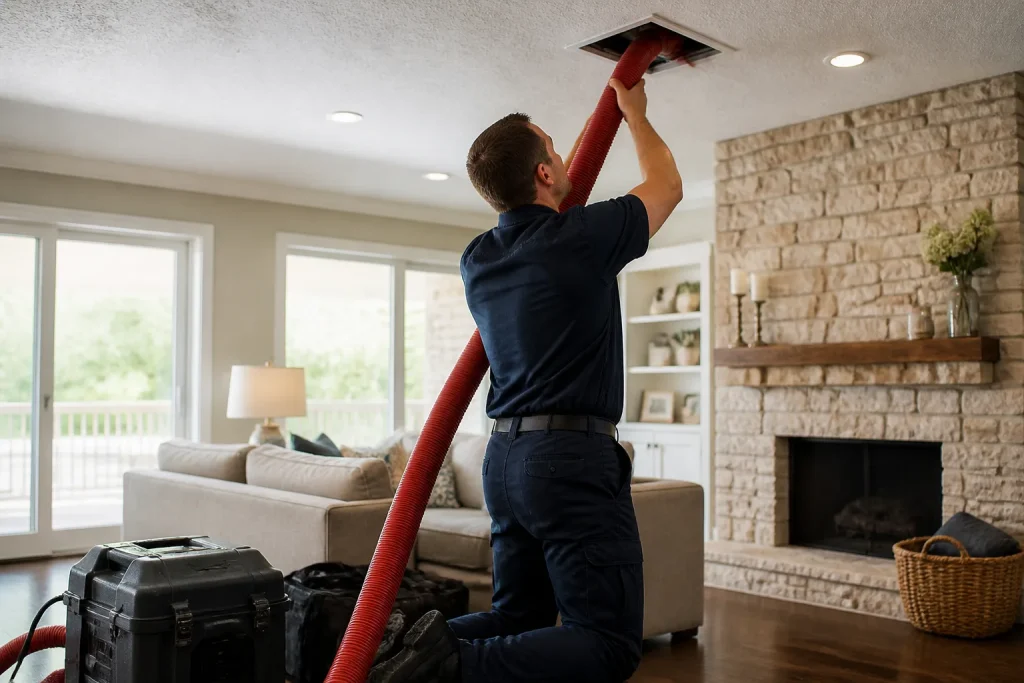
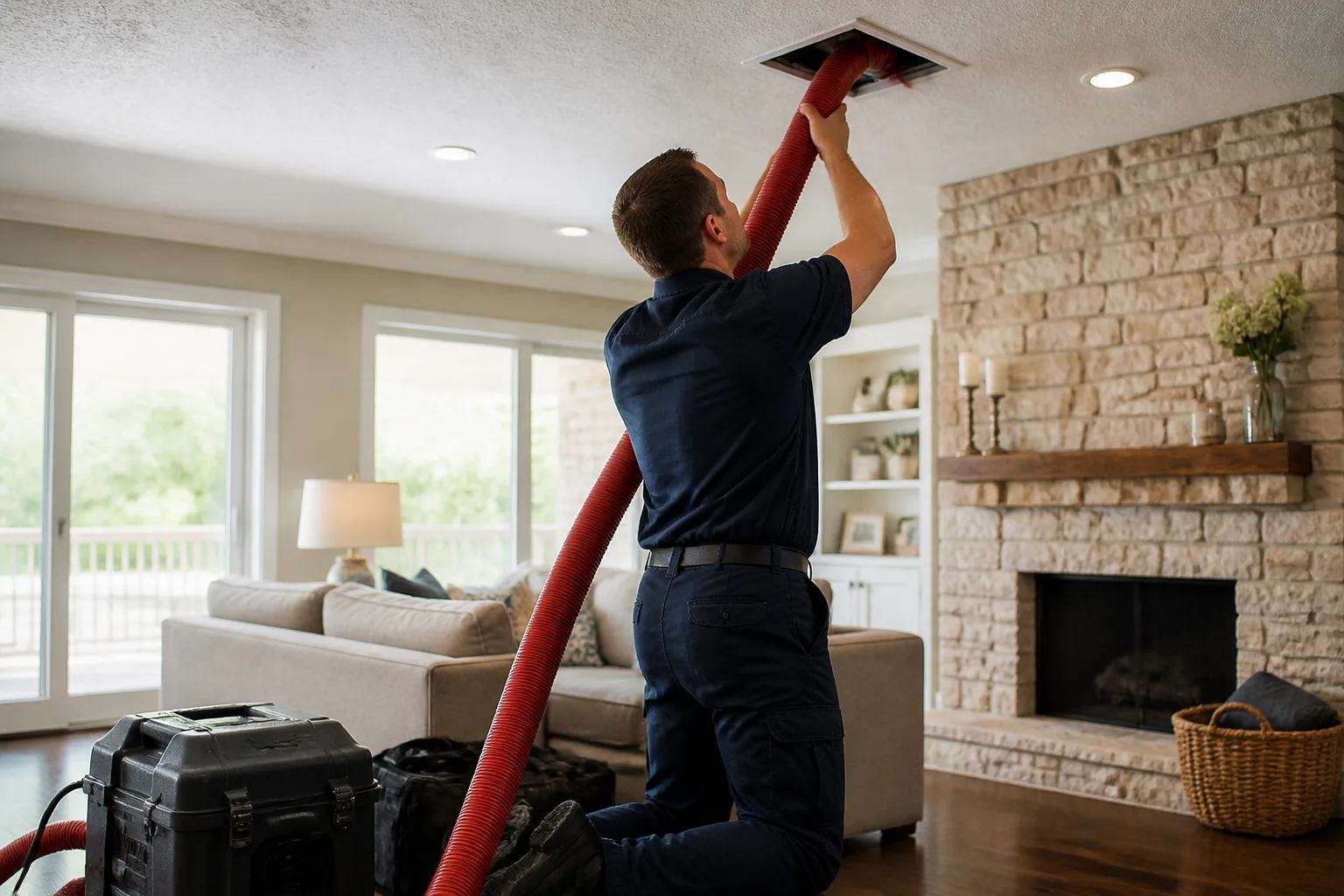
- Mechanical duct cleaning. Rotary brush agitation through every supply and return run, with negative-air suction holding the debris in the collection system so it leaves the house rather than redistributing. We use Rotobrush rotary brush systems and Nikro negative-air machines for exactly this reason – they’re engineered for duct work, not repurposed wet-dry vacs.
- Inspect and address duct integrity. Cleaning exposes what the debris was hiding: disconnected sections, torn flex, leaking joints. Installing an air cleaner on a leaking duct system is a waste of the equipment’s capacity.
- HVAC component cleaning. The blower wheel, coil, and cabinet interior. This is the surface Honeywell UV and filtration products actually treat.
- Sanitizing with air scrubbing. Abatement Technologies air scrubbers run during this step so contaminants are captured rather than left airborne in your living space.
- Honeywell installation or service. Only now does the F300, UV100, or ventilation control get installed or serviced – into a system where it can perform to spec.
We handle all of that under one roof, which matters because the alternative is coordinating a duct cleaner, an HVAC tech, and an IAQ installer and hoping they agree on sequence. Our air duct cleaning North Hills service covers the mechanical stage, and our HVAC cleaning work handles the equipment side.
What Honeywell Products Address – and What They Don’t
Honeywell IAQ equipment is genuinely capable within its lane. Being clear about that lane is how you avoid buying the wrong fix.
What Honeywell equipment addresses
- Airborne particulates. An F300 electronic air cleaner captures charged particles from the airstream passing through it – pollen, fine dust, smoke particles.
- Biological growth at the coil. A UV100 germicidal lamp shines UV-C energy on the evaporator coil, where moisture creates conditions for microbial growth. This is a coil-level treatment.
- Fresh-air exchange. A Honeywell HRV or ERV brings in outdoor air while recovering energy from the exhaust stream, which matters in a tight North Hills home where stale air accumulates.
What Honeywell equipment does not address
- Settled debris in duct runs. No air treatment device removes the layer of dust sitting on the duct floor. That’s mechanical cleaning, period.
- Duct leakage. A leaking joint loses conditioned air regardless of how clean the airstream is at the air handler.
- Disconnected or collapsed sections. A UV lamp doesn’t reconnect a separated flex run. Duct repair does.
The honest framing: Honeywell products manage air quality at the equipment. They don’t rehabilitate the distribution system. Both jobs matter, and they’re not interchangeable.
Integrating Honeywell IAQ Into a Full-System Service Visit
The reason to fold Honeywell equipment into a full-system visit rather than booking a separate IAQ contractor is simple: the same technician who cleans your ducts can see the coil, the blower, the return plenum, and the duct runs in one pass. That context is what makes an equipment recommendation accurate instead of generic.
In practice, a full-system visit in North Hills looks like this. We clean the supply and return ducts, then move to the air handler and clean the blower and coil. We check duct integrity and seal what we find leaking. We run the sanitizing step with air scrubbing in place. Then we assess whether a Honeywell F300, UV100, or ventilation control is a fit for the system we just cleaned – and if one is already installed, we service it in the same visit. Because duct repair and sealing is in-house, a leak found during cleaning gets fixed on the spot rather than becoming a second appointment with a different trade.
The same full-system approach covers dryer vent cleaning, which matters for safety as much as air quality: lint accumulation in a dryer vent is a leading cause of residential fires, and it’s a documented risk that a Honeywell filter won’t touch. While we’re already in the home, that vent gets cleared too.
Maintenance: How Dirty Systems Accelerate Honeywell Service Cycles
Every Honeywell IAQ product carries a maintenance interval, and every one of those intervals stretches or shrinks depending on how clean the surrounding system is. This is where duct condition quietly drives cost.
- F300 electronic air cleaner cells. Manufacturer guidance calls for periodic washing of the collection cells. In a home with dirty return ducts, cells load noticeably faster and need cleaning more often – and a heavily loaded cell drops in efficiency before it fails outright.
- UV100 germicidal lamps. UV lamps degrade gradually and are typically replaced on a set schedule. A coil that’s fouled with debris means the lamp’s energy is absorbed by grime rather than reaching the coil surface, so you’re paying for lamp hours that aren’t doing their job.
- HRV/ERV cores and filters. Ventilation cores and their filters clog quickly when the return air feeding them carries heavy particulate. Dirty ducts shorten that cycle directly.
We stock and service Honeywell and Aprilaire air-quality products, so a filter or lamp replacement doesn’t have to become a parts-ordering saga. And we’ll tell you honestly when the maintenance interval is being shortened by system condition rather than by the device itself – that’s usually a sign the ducts need attention again.
When to Call a Pro
Some of this you can check yourself. Look at the return grilles for visible dust trails. Check whether the F300 cells are gray with buildup. Notice if the UV lamp is dark on inspection – you can see the glow through the access panel on most installations. When you spot any of that, a pro is the right call, because the fix involves mechanical cleaning and inspection you can’t perform through a grille. High-voltage components inside an air cleaner and UV-C light are genuinely hazardous to handle with the power on; a trained technician should do the servicing, and we don’t recommend opening those compartments yourself.
If you’re in North Hills and want the full-system version done right, air duct cleaning through our team includes the inspection that tells you what Honeywell equipment will actually accomplish in your home. Related services in North Hills include the full airflow chain – supply and return ducts, dryer vents, HVAC components, sanitizing, and duct repair – all from one team, so you’re not juggling three contractors. Call (844) 443-4850 for a free estimate.
The Bottom Line
Honeywell air quality products work at the air handler: particulates captured, coil biology treated, fresh air exchanged. Duct cleaning works at the distribution system: debris removed, integrity restored. Clean ducts come first, Honeywell equipment functions best on a system that’s been cleaned, and neither replaces the other. In North Hills, we’ve seen the pattern enough to say it plainly – clean the system, then treat the air. Our technicians have up to 12 years of experience with professional-grade Rotobrush and Nikro systems, Abatement Technologies air scrubbing, and Honeywell and Aprilaire products, and we’ve arranged every estimate as one flat price per system agreed before work starts.
If you’re in North Hills and need help, Air Duct Cleaning North Hills offers free estimates – call (844) 443-4850. We answer 24/7. Fast dispatch from 7am to 7pm, Sunday through Friday.
Frequently Asked Questions
No. Honeywell manufactures air quality products – electronic air cleaners like the F300, UV germicidal lamps like the UV100, and ventilation systems – but not duct cleaning machinery. Duct cleaning uses rotary brush and negative-air vacuum systems such as Rotobrush and Nikro. The two categories of equipment serve different jobs.
After. Mechanical duct cleaning should come first, then HVAC component cleaning, so the UV lamp is mounted at a coil that’s been cleaned rather than one covered in debris. Installing a lamp first just means the UV energy hits grime instead of the coil surface. Call (844) 443-4850 for an exact quote on a combined visit.
Not by itself. An electronic air cleaner captures airborne particulates passing through it but doesn’t remove debris settled inside the duct runs. For settled dust you need professional cleaning with agitation and suction. The air cleaner is the second step, not the first. Call (844) 443-4850 for a free estimate.
F300 collection cells need periodic washing, UV100 lamps are replaced on a set schedule, and ventilation cores and filters need cleaning or replacement at intervals set by the manufacturer. A dirty duct system shortens all of those intervals because the equipment is working harder against a heavier load. A cleaned system keeps you closer to the intended maintenance schedule.
Written by the team at Air Duct Cleaning North Hills.
Need Air Duct Cleaning Help?
Call Air Duct Cleaning North Hills - the local pro we connect you with is licensed and insured, here with fast help in North Hills.
(844) 443-4850